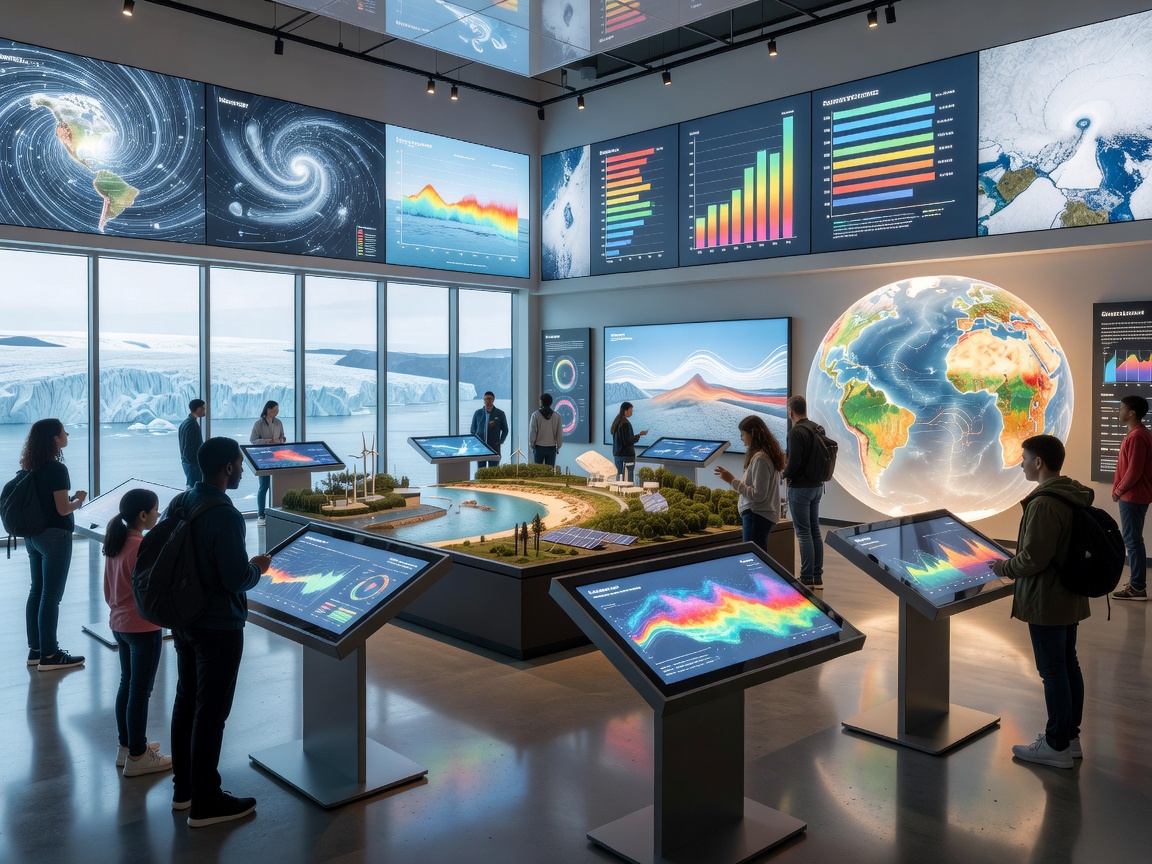
Climate research centers bring several activities together. Some support field measurements. Some maintain instruments, archives or demonstration systems. Some include public galleries. Their common feature is a direct relationship with environmental observation.
What happens inside
Observation begins with a place, a question and a method. Staff may monitor air, water, soil, ice, vegetation or atmospheric conditions. A visitor display can show the instrument, its position and the type of record it creates. The display should also explain what the instrument cannot establish on its own.
Field measurements are often combined with records from other locations. Atmospheric research may examine temperature, pressure, wind, particles or cloud conditions. Ocean and cryosphere work may focus on water properties, sea ice, snow or glacier change. Ecosystem observation can track seasonal activity, habitat conditions and interactions between living systems.
Research is not the same as a museum collection
Research center
- Shows active observation and method.
- Connects instruments to current questions.
- May have limited public access.
- Information can change with ongoing work.
Traditional museum
- Often prioritizes collections and historical context.
- Usually offers a stable interpretive sequence.
- May use fewer live monitoring systems.
- Can provide broader cultural coverage.
Why public education matters
Public interpretation makes scientific process visible. Good exhibits distinguish a direct measurement from a calculated indicator. They identify time scale, location and uncertainty. They avoid presenting one sensor or one visit as a complete description of a complex system.
The strongest centers also connect indoor interpretation with outdoor conditions. A weather station, river edge, forest plot or shoreline can become an observation point. Visitors learn to compare a local scene with a wider record.
Good for
- Visitors who want method before conclusion.
- Students studying geography, physics or ecology.
- Families who prefer practical demonstrations.
- Travelers planning a science-focused destination.
What to know
Access may be limited because research spaces are operational environments. Guided sessions, school programs and galleries can follow different schedules. Check the destination’s official information before travel. Do not assume that a visible instrument is available for handling or that all research areas are open.
Related guides
Environmental monitoring exhibits explain instruments. Climate data and visualization explains the records they produce. For logistics, use the visit planning guide.